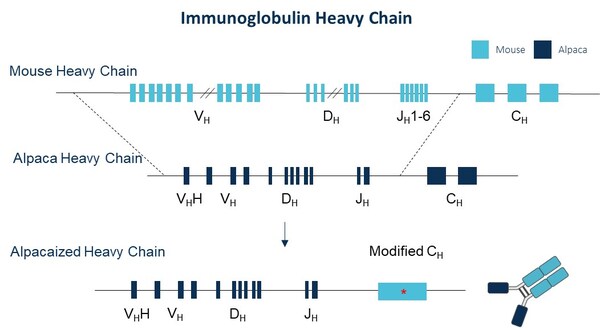
BOSTON, June 1, 2024 /PRNewswire/ — Immunocan announces significant progress in the construction of its alpaca-derived nanobody discovery platform, ImmuAlpaca® mouse. The IGH-VDJ genes in the mouse genome have been successfully replaced by alpaca IGH-VDJ genes in-situ.
In 1993, naturally occurring heavy-chain-only antibodies (HCAbs) were discovered. Compared to the heavy chain variable regions of traditional antibodies, the variable domain of heavy chain of HCAbs (VHH) from camelids (also known as nanobodies) have four aliphatic amino acid residues in the FR2 region replaced by hydrophilic amino acids. This substitution confers greater stability in the absence of a light chain. Nanobodies are the smallest antigen-binding fragments found in nature. With a molecular weight of only 15 kDa, nanobodies offer great flexibility and are easy to use as components for constructing therapeutic molecules in innovative format such as multivalent and multispecific antibody molecular structures. Over the past 20 years, extensive research and development achievements have demonstrated the significant value of nanobodies in clinical therapeutic use.
|
Brand |
Disease |
Target |
Company |
Approval |
|
Cablivi® |
Acquired thrombotic |
Von Willebrand |
Ablynx NV |
Approved |
|
Carvykti® (Ciltacabtagene |
Refractory/relapsed |
B-cell |
Legend Biotech/ |
Approved |
|
Nanozora® |
Rheumatoid arthritis |
Tumor necrosis |
Ablynx NV/ |
Approved |
|
Enweida® |
MSI-H or dMMR |
Programmed |
Alphamab Oncology/ 3D |
Approved |
Currently, nanobodies can be obtained mainly through three approaches: camelid immune libraries, naïve camelid libraries, and fully synthetic libraries. Among these, camelid immune libraries are the most widely used for screening. However, due to the large size and low reproductive rate of camelids, the required antigen amount for immunization is high and the immunization strategy employed in one discovery campaign is limited. Besides, lacking standardized breeding and experimental facilities further impacted their reliability and performance. A novel approach is needed to keep up with the increasing demand for nanobody-based drug discovery.
Immunocan has developed the innovative camelid-derived nanobody discovery platform, ImmuAlpaca® mouse, through patented MASIRT® technology. This platform enables nanobody discovery using robust strategy and methods from standard mice model. MASIRT® technology involves replacing the IGH-VDJ (Variable, Diversity and Joining segments of immunoglobulin heavy locus) genes in the mouse genome with camelid-derived IGH-VDJ genes in-situ. Immunization of ImmuAlpaca® mouse can generate highly diversified nanobody libraries. This allows for the use of diversified immunization and antibody screening strategies common in mouse models, significantly improving the performance of nanobody molecule discovery.
|
ImmuAlpaca® Mouse |
Camelids |
|
|
Reduction in Antigen Usage |
ug per individual |
mg per individual |
|
Immunization Strategy Diversity |
Multiple groups of mouses with |
Single strategy for one camelid |
|
Screening Strategy Diversity |
Hybridoma screening, single B |
Phage and yeast library screening |
In addition to the ImmuAlpaca® mouse, Immunocan has already developed the ImmuMab Heavy® mouse, generating fully human heavy-chain-only antibodies and is constructing the ImmuHeavy® rabbit, generating rabbit heavy-chain-only antibodies. Using these models will expand the sequence space for nanobody discovery at multiple level. By leveraging the advantages of antibody sequences and structures from different species, exploring more target epitopes and therapeutic mechanisms will be easier.
|
ImmuAlpaca® |
ImmuMab Heavy® |
ImmuHeavy® |
|
|
Molecular Origin |
Camelid |
Human |
Rabbit |
|
Molecular Feature Advantages |
Good hydrophilicity, |
No need for humanization |
High affinity, high diversity |
Immunocan will continue to innovate with multi-species antibody discovery platforms to accelerate the development of novel therapeutics and drugs. Immunocan is looking forward to introducing its innovative antibody discovery platforms to global research partners and seek collaboration to bring safer and more effective therapeutic products to patients worldwide.
About the Massive-fragment Across Species In-situ Replacement Technology (MASIRT®)
Immunocan’s core technology features one-step gene replacement at Mb scale between two species. Its advantageous genome-engineering efficiency enables rapid construction of multiple specialized antibody discovery platforms, including mice generating fully human antibodies or alpaca antibodies and rabbits generating fully human antibodies (under construction).
About Immunocan
Immunocan was founded in 2020 and specializes in using gene editing technology to replace immunoglobulin variable region genes in various animals, resulting in genetically engineered animals capable of producing fully human antibodies and other innovative modalities. The company is committed to offering cutting-edge antibody discovery platforms to worldwide drug research partners, with the goal of developing safer and more effective treatments for human diseases.
Media Contact
Youyang Shen
shenyouyang@immunocan.com