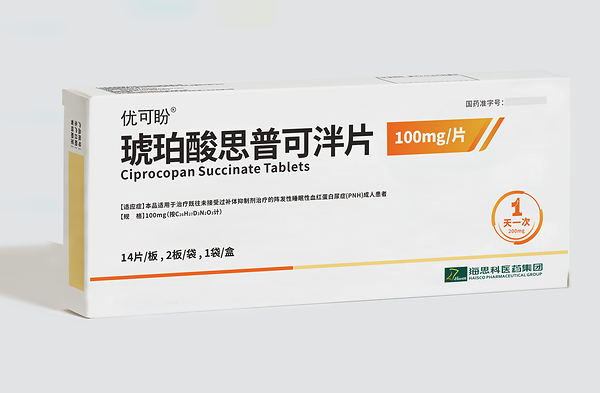
BEIJING, July 23, 2026 /PRNewswire/ — Haisco Pharmaceutical Group claimed today their independently developed Class 1 innovative drug, Ciprocopan Succinate Tablets (development code: HSK39297), has received marketing approval from the National Medical Products Administration of China (NMPA) for the treatment of adult patients with Paroxysmal Nocturnal Hemoglobinuria (PNH) who are complement-inhibitor-naïve. This is Haisco’s fifth innovative drug approved for marketing and represents an important advance in the treatment of complement-mediated diseases in China. As the world’s first once-daily oral complement factor B (FB) inhibitor, Ciprocopan Succinate Tablets offers patients with PNH a new, safe and convenient treatment option.
Focusing on Rare Diseases and Addressing Unmet Clinical Needs
Paroxysmal Nocturnal Hemoglobinuria (PNH) is a rare, acquired clonal disorder of hematopoietic stem cells. The disease is primarily characterized by intravascular hemolysis, bone marrow failure, and venous thrombosis. Ongoing hemolysis may cause fatigue, renal impairment, pain, dyspnea, and other symptoms. Studies have shown that, before complement inhibitors became available, patients with PNH had a poor prognosis.

Conventional management of PNH primarily includes supportive care, prevention and treatment of thrombosis, and allogeneic hematopoietic stem cell transplantation; immunosuppressive therapy may be used in patients with concomitant bone marrow failure. According to the Chinese Guideline for the Diagnosis and Treatment of Paroxysmal Nocturnal Hemoglobinuria (2024 Edition), treatment of PNH should be based on clinical subtype, and complement inhibitors are recommended as first-line therapy for classic PNH.
Although advances in complement-targeted therapies have improved the treatment of PNH in recent years, patient needs remain largely unmet. C5 inhibitors can control intravascular hemolysis but do not block upstream complement activation. Some patients continue to experience residual anemia, fatigue, or a need for transfusions. Traditional twice-daily dosing regimens carry a risk of breakthrough hemolysis. Patients need new therapies that are effective, convenient, and suitable for long-term disease management.
Ciprocopan Succinate Tablets is a highly potent and selective small-molecule complement factor B (FB) inhibitor developed independently by Haisco with full intellectual property rights. Using a structure-based approach, Haisco’s R&D team identified opportunities for optimization and incorporated metabolically stabilizing groups to shield metabolic soft spots at the source. By targeting a key step in the alternative complement pathway, the compound inhibits both pathway initiation and the alternative-pathway-mediated amplification loop, thereby suppressing activation of the complement system and delivering therapeutic efficacy in complement-mediated diseases.
As an innovative oral small-molecule therapy, Ciprocopan Succinate Tablets is administered once daily. No dosage adjustment is required in patients with mild or moderate renal impairment or in patients with mild, moderate, or severe hepatic impairment. No dosage adjustment is required when the product is coadministered with strong CYP2C8 inhibitors, and it may be taken without regard to food, improving treatment convenience and adherence.
Advancing Innovation and Expanding the Innovative Medicine Portfolio
Innovation is a core pillar of Haisco’s strategy. From project initiation through clinical development, and from scientific exploration to successful commercialization, Ciprocopan Succinate Tablets represents a major milestone in Haisco’s sustained investment in R&D and innovation.
Guided by its innovation and globalization strategy and supported by the strong innovation ecosystem and biopharmaceutical industry environment in Sichuan Province and Chengdu, Haisco continues to increase investment in innovation. The company has built an R&D team of more than 1,000 professionals focused on key therapeutic areas, including anesthesia and pain management, chronic and metabolic diseases, gastrointestinal and liver diseases, respiratory diseases, autoimmune diseases, and oncology. Annual R&D investment has exceeded RMB 1 billion for several consecutive years, accelerating the translation of innovation into products.
Haisco Pharmaceutical Group has established 5 modern manufacturing sites and more than 30 production lines across China to accelerate the industrialization of its innovative products. The Group has 27 Class 1 innovative drug programs and has established a tiered R&D pipeline spanning preclinical research and Phase I, Phase II, and Phase III clinical trials. Four Class 1 innovative drugs—Cipepofol Injection, Anrikefon, Cofrogliptin, and Crisugabalin—have received marketing approval, all of which are included in China’s National Reimbursement Drug List (NRDL).
Cipepofol Injection, an innovative intravenous anesthetic with independent intellectual property rights, received marketing approval from the U.S. Food and Drug Administration (FDA) in late May of this year. It is the first China-originated intravenous anesthetic new drug to enter the global market, marking a breakthrough from “new in China” to “new for the world”.
The successful approval and launch of Ciprocopan Succinate Tablets marks another breakthrough for Haisco in the frontier of global innovation in complement-mediated disease treatment and further enhances the company’s innovative medicine portfolio.
International Partnerships: Taking China-Originated Innovation Global
Haisco is advancing its Innovation and Globalization Strategy 2.0, expanding its presence in global innovation markets, and continuously strengthening its international clinical development and global collaboration capabilities.
Ciprocopan Succinate Tablets is also a key program in Haisco’s globalization strategy. In June 2026, Haisco entered into an Exclusive License Agreement with U.S.-based Nuvectis Pharma, Inc., granting Nuvectis exclusive rights to develop, manufacture, and commercialize HSK42360 (a BRAF inhibitor) globally outside Greater China, as well as exclusive rights to develop, manufacture, and commercialize HSK39297 (the ciprocopan succinate program) globally outside Greater China, Southeast Asia, and India.
As part of the consideration for the out-license transaction, Haisco will receive license payments for the HSK42360 and HSK39297 programs, including a total of $40 million in upfront and near-term milestone payments and up to $1.421 billion in additional milestone payments. Haisco will also be eligible to receive tiered royalties of up to double-digit percentages on future net product sales. Together, the companies will work to make these products available to more patients worldwide.
In recent years, Haisco has accelerated its globalization efforts and entered into innovative drug R&D collaborations and international licensing agreements with several global pharmaceutical companies, including AbbVie, Eli Lilly, and Nuvectis, across key areas such as oncology and autoimmune diseases. These collaborations are helping bring China-originated innovative medicines to international markets. China’s innovative drug R&D capabilities are gaining increasing global recognition.
Looking ahead, Haisco will continue to pursue its innovation and globalization strategy, focus on major disease areas and unmet clinical needs, accelerate the development and global expansion of original innovative medicines, and further strengthen its independent innovation capabilities. The company aims to build an internationally competitive portfolio of innovative medicines, bring more China-originated therapies to patients worldwide, and contribute to the Healthy China initiative and global biopharmaceutical innovation.
Further Reading
[About Paroxysmal Nocturnal Hemoglobinuria (PNH)]
Paroxysmal Nocturnal Hemoglobinuria (PNH) is a rare, acquired clonal disorder of hematopoietic stem cells. Acquired PIGA mutations in hematopoietic stem cells cause deficiencies in complement-regulatory proteins, including CD55 and CD59, and constitute the principal molecular basis of complement-mediated intravascular hemolysis in PNH. PNH is primarily characterized by intravascular hemolysis, bone marrow failure, and venous thrombosis. Ongoing hemolysis may cause fatigue, renal impairment, pain, dyspnea, and other symptoms. Studies have shown that, before complement inhibitors became available, patients with PNH had a poor prognosis.
Conventional management of PNH primarily includes supportive care, prevention and treatment of thrombosis, and allogeneic hematopoietic stem cell transplantation; immunosuppressive therapy may be used in patients with concomitant bone marrow failure. According to the Chinese Guideline for the Diagnosis and Treatment of Paroxysmal Nocturnal Hemoglobinuria (2024 Edition), treatment of PNH should be based on clinical subtype, and complement inhibitors are recommended as first-line therapy for classic PNH.
[Three Advances in the Clinical Benefits of Ciprocopan Succinate Tablets]
Enabled by deuterium substitution technology, Ciprocopan Succinate Tablets delivers three major advances in clinical benefit for PNH. A head-to-head Phase III study in China showed a hemoglobin target-attainment rate of 59.5%, a hemoglobin increase of 48.35 g/L, and reduced transfusion requirements; 94.6% of patients were transfusion-free, helping conserve healthcare resources. The incidence of treatment-emergent adverse events (TEAEs) was lower, and no adverse events led to treatment discontinuation or study withdrawal; the product also offers convenient once-daily oral dosing and a prolonged half-life of 21–38 hours.
[Selected Scientific Conference Presentations on Ciprocopan Succinate Tablets]
Results from two Phase III clinical studies of Ciprocopan Succinate Tablets were accepted for presentation at the 2026 Congress of the European Hematology Association (EHA). One was a randomized controlled study in patients with PNH who were complement-inhibitor-naïve, and the other was a single-arm study in patients with persistent anemia despite stable treatment with a C5 monoclonal antibody.
These two studies included a broad population of patients with PNH and both yielded positive results, demonstrating robust efficacy and a favorable safety profile. Once-daily oral monotherapy with Ciprocopan Succinate Tablets may provide sustained and comprehensive disease control for patients with PNH, together with a favorable safety profile and the potential for long-term treatment, underscoring its innovative value and global competitiveness in PNH care.
[References]
- Red Blood Cell Diseases (Anemia) Group, Chinese Society of Hematology, Chinese Medical Association. Chinese Guideline for the Diagnosis and Treatment of Paroxysmal Nocturnal Hemoglobinuria (2024 Edition). Chinese Journal of Hematology, 2024, 45(8): 727-737.
- Hillmen P, Lewis SM, Bessler M, et al. Natural history of paroxysmal nocturnal hemoglobinuria. N Engl J Med, 1995, 333(19): 1253-1258.
- Dingli D. Improved therapy for paroxysmal nocturnal hemoglobinuria. Ann Blood. 2026;11:8. doi:10.21037/aob-2025-1-62
- Xu G, et al. Efficacy and safety of switching to oral HSK39297 monotherapy in paroxysmal nocturnal hemoglobinuria patients with persistent anemia despite anti-C5 therapy: a phase 3 study (HSK39297-302). Presented at EHA 2026; Abstract PS1786.
- Phase III Clinical Study Report of HSK39297 Tablets
- Prescribing Information for Ciprocopan Succinate Tablets;
- Claxton AJ, Cramer J, Pierce C. A systematic review of the associations between dose regimens and medication compliance. Clin Ther. 2001;23(8):1296-1310.
- Risitano AM, et al. Br J Haematol. 2022;196:288-303.
- Hillmen P, et al. N Engl J Med. 2006;355:1233-1243.
- Peffault de Latour R, et al. Blood. 2015;125(5):775-783.4. Panse J, et al. Value Health. 2023;26(Suppl):S468..
- Dingli D, et al. Ann Hematol. 2022;101:251-263.
Disclaimer:
This material is intended to provide current medical information and research updates for healthcare professionals only. It is not intended for product promotion or advertising. The content herein is not a substitute for professional medical judgment and should not be construed as diagnostic or treatment advice. Healthcare professionals should refer to and strictly follow the most current full prescribing information when prescribing any product discussed herein. For the complete disclaimer, visit: https://www.haisco.com/statement.html.
Source: Haisco Pharmaceutical Group Co., Ltd.